


- Ph. D. 2020
Geophysics
Université Grenoble Alpes, France
- M. Sc. 2016
Climate System: Hydrosphere, Cryosphere
Université Grenoble Alpes, France
- M. Sc. 2016
Natural Geological Hazards and Risks
Institut Polytechnique LaSalle Beauvais, France

You can reach Greg at gregoire_guillet@sfu.ca.
Meet Greg
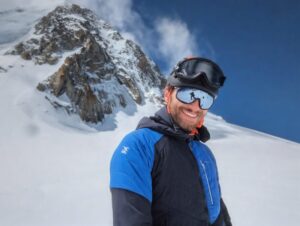
Greg holds a PhD in Earth System Sciences from Université Savoie Mont Blanc, where he investigated serac falls and the dynamics of ice and snow cover in the Mont Blanc massif. His doctoral research examined the behavior of unstable alpine ice formations, where understanding ice dynamics is essential to understanding how failures develop and potentially lead to hazardous ice falls. He subsequently held postdoctoral positions at the University of St Andrews, the University of Washington, and the University of Alaska Fairbanks, focusing on the physical processes underlying glacier destabilization and surges. This work explored how glaciers deform, evolve, and sometimes undergo rapid changes in motion, with implications for understanding and anticipating potentially hazardous glacier instabilities. Before joining SARP in October 2026, Greg was a research scientist at the University of Oslo, where he led the development of the Unified Probabilistic Glacier Model (UPGEM), a Bayesian framework that combines satellite observations with glacier dynamics models to estimate ice flow and quantify its uncertainty. His research has also received support from NASA grants. Outside of the lab, Greg is passionate about the mountains, with a particular enthusiasm for ice climbing and ski touring. Drawn to the same alpine environments that motivate his scientific work, he enjoys exploring them firsthand, where steep ice faces, complex snow conditions, and dynamic mountain terrain offer challenges well beyond the lab.
Greg's research
Greg is a geophysicist specializing in alpine mass movements, including snow avalanches, serac falls, hanging glacier collapses, and glacier surges. His research focuses on two complementary questions: the physical processes that drive these instabilities and how they can be better forecast. On the physics side, he investigates how instabilities develop and eventually lead to failure. This includes understanding how weaknesses form and propagate within the snowpack, as well as how liquid water moving through the snow influences the onset of wet-snow slab and glide avalanches. On the forecasting side, he explores probabilistic approaches, including Bayesian inference and machine learning, to improve the integration of snowpack models with field observations and remote sensing data. By combining physical process understanding with data-driven methods and rigorous uncertainty quantification, he aims to develop more reliable avalanche forecasting tools. At SARP, Greg aims to translate these advances into operational practice, integrating physics-based modeling, observational data, and probabilistic methods into avalanche forecasting in Canada.