


Project Overview
Snowpack models are an increasingly important tool in Canadian avalanche forecasting, especially as practitioners rely more on model output to support hazard assessments in data-sparse regions. However, these models depend heavily on numerical weather prediction (NWP) inputs—particularly precipitation—which is one of the largest sources of uncertainty. Forecast errors can lead to cumulative biases in simulated snowpack height and structure over the course of the winter season. Improving the reliability of these models is critical for operational use.
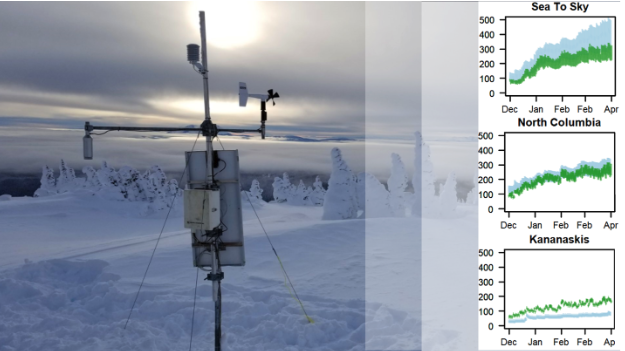
This project explored multiple strategies for evaluating and improving snowpack model performance. One component focused on using snow depth observations, a routinely collected and easily interpretable metric, as a real-time check on model accuracy. We developed methods to aggregate data from automated weather stations, manual plots, and field observations into regional estimates, then compared these with modelled values to assess reliability. A simple correction method for major snowfall errors was implemented and tested in Avalanche Canada’s operational systems, improving alignment between observed and simulated snowpack height and supporting future data assimilation work.
A second component examined how different precipitation products affect snowpack simulations. Using SNOWPACK model runs at 28 sites across western Canada, we compared simulations driven by four different precipitation datasets to reference simulations constrained by daily observed snow depth. Project partners at the University of Sherbrooke and Environment and Climate Change Canada provided new experimental versions of the Canadian Precipitation Analysis (CaPA) that blended models with observations. Results showed that all products tended to overestimate snow height, but a new experimental version of CaPA generally performed best. Still, regional variability was significant, and no single product was optimal in all conditions. These insights help forecasters understand the strengths and limitations of different input datasets and guide the selection of appropriate data sources for snowpack modelling.
Our findings highlight that accurate precipitation input remains one of the key challenges in snowpack modelling. While correction methods and evaluation tools can improve model performance, uncertainty in precipitation data continues to limit reliability. Future work should explore ensemble weather products to better characterize and manage these uncertainties.
Involved Researchers
- Simon Horton
- Kelsea Krawetz
- Florian Herla
- Jean-Benoit Madore
- Vincent vionnet
Partner Organizations
- Avalanche Canada
- University of Sherbrooke
- Environment and Climate Change Canada
Project Funding
Relevant Publications

Assessing the impact of precipitation inputs on snowpack simulations in Western Canada

Assessing the impact of precipitation inputs of snowpack simulations in Western Canada
